Is Popp's Ferry Road the Next Major Development Corridor on the Mississippi Gulf Coast?
For most of my life, west Biloxi was the part of town you drove through to get somewhere else. The neighborhoods were strong. The schools were strong. But the corridor — Popp's Ferry Road, from I-10 across the Back Bay — stopped at Pass Road, a mile short of the beach, and the area carried the look of a place still deciding what it was.
This winter, Popp's Ferry punches through Pass Road like a solid right hand into an area that needed a good punch in the face. And it lands at a time when this community has already rebuilt itself. That's the order of events some people are missing: the road is not the beginning of west Biloxi's comeback. It's the last piece of it.
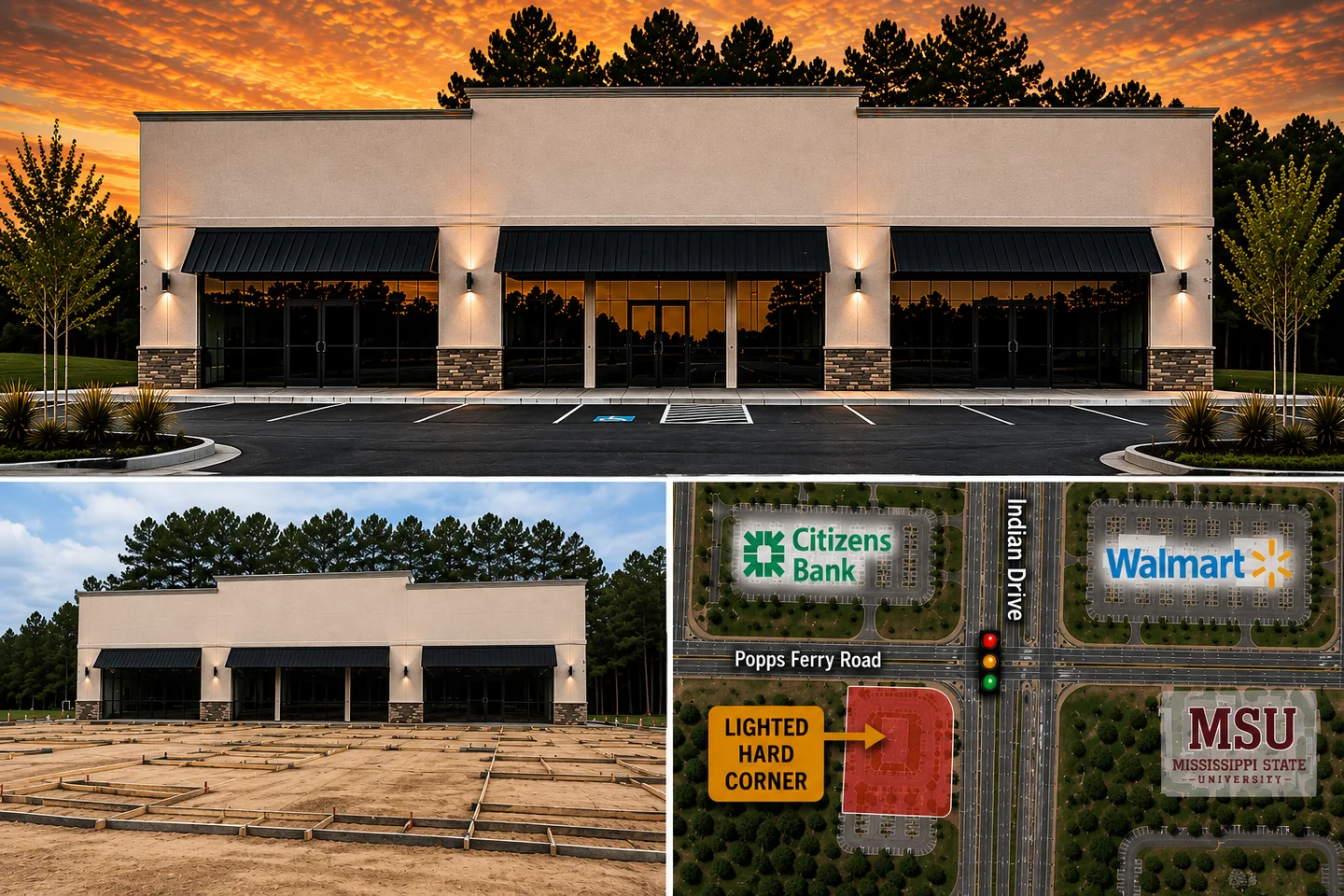
My firm has developments underway in this area, on Indian Drive and Popp's Ferry, so I'm not exactly neutral, but that doesn't change the facts. The numbers speak for themselves, and the sources are public: the City of Biloxi, the State of Mississippi, and the U.S. Census Bureau.
The in-between years
Two indicators tell you what's happened here for a long time. One is the shopping center at Popp's Ferry Road and Pass Road — 2384 Pass Road, the corner. The other is the thoroughfare identity Popp's Ferry has always had. It's been a transitional thoroughfare, a road leading from one point to the next. It was never really a destination.
A Winn-Dixie opened on that Popp's Ferry Road and Pass Road corner in 1971, in the shopping center that anchored this end of town. For almost fifty years, that store was where west Biloxi bought its groceries. In 2018, Winn-Dixie's parent company went through bankruptcy and closed it. The box sat empty for five years.
An empty grocery store does something to an area that goes past retail. It's the biggest, most visible building in the neighborhood, dark. Everybody drives past it every day. It subconsciously tells residents their town is in decline. And it tells other retailers watching the market the same thing. West Biloxi spent those years as a pass-through — good people, good schools, and a corridor the market had stopped believing in.
What the community did while it waited
After the breakup, when the anchor sat empty, the community focused on itself. It built itself up like someone who was looking for true love again. Someone who wanted to truly attract the right anchor.
The Biloxi School District kept earning A ratings from the state. Biloxi High School and Biloxi Junior High sit on the campus off Popp's Ferry at Tribe Drive. North Bay Elementary is on Popp's Ferry Road itself. And a new Biloxi Upper Elementary — grades 5 and 6, with a gym and an activity field — is going up on 37 acres at Popp's Ferry and Motsie Road, set to open in late fall 2027. The district picked that site, in its own words, "because of the increasing population north of the bay."
The athletic facilities match. The A.J. Holloway Sports Complex, 68 acres just south of Popp's Ferry and Cedar Lake, has three soccer fields, four softball fields, an adult baseball field, five little league fields and tennis courts, all lighted — renovated top to bottom, finished in March 2025. The Popp's Ferry Recreational Area, next to the library, has pickleball courts, a walking track, a splash pad and the dog park. At the north end of the bridge, the city bought the 10-acre causeway in 2000 and kept it public: a boat ramp on the Tchoutacabouffa River, fishing and crabbing piers, boardwalks, a restaurant you can tie a boat up to, and a lit promenade where the benches face the sunset.
And the housing followed. The good multifamily out here keeps a wait list. Not at a discount. Consistently. This place is coveted, and it should be. The community supports this corridor. The community buys here. And the community sells here — to the next family that wants the same thing.
Most corridors get a new road and hope a community shows up. West Biloxi did it the other way around.
How the road got here
Biloxi first put this extension on paper in March 2004, under Mayor A.J. Holloway. The city didn't pitch it as convenience. It pitched it as an evacuation route. Back then, a city of 50,000 people, plus the tourists, had one real way out in a storm: Interstate 110. The Popp's Ferry drawbridge — built in 1979, still west Biloxi's main artery — opens for boat traffic all day long and backs cars up behind it. Holloway said it plainly: "This bridge is a vital emergency evacuation route… in a best-case scenario, this current bridge is still going to be a bottleneck."
Then Katrina closed that bridge for over four months. In 2009, a barge tow knocked two sections of it into the bay. The road still stopped at Pass Road.
Federal approval finally came in September 2016, at $8 to $10 million. Bids were supposed to go out in 2018. They didn't. The money had to be put together piece by piece — Rep. Kevin Felsher's word for it at the groundbreaking was "cobbled." A $3 million restoration grant. $2 million from Harrison County. MDOT and regional planning money. A $6 million federal earmark moved over from another connector that never got built. To get the railroad's approval for the new crossing, Biloxi closed three rail crossings in East Biloxi.
The construction contract ended up at $20.8 million, in a project reported at about $27 million all-in. Ground broke on October 16, 2024.
That same morning, across the intersection, Rouses opened its doors.
The right anchor showed up
Remember the empty box at 2384 Pass Road. In January 2023, Rouses Markets signed a lease on it: 60,000 square feet, a full remodel inside and out, its first store in Biloxi. A family grocery chain out of Louisiana — and nobody's idea of a discount operation. The city said the quiet part in its own announcement: "The development is a direct result of our plans to extend Popp's Ferry to U.S. 90."
Read that again. The road wasn't built yet. It wasn't even funded to the last dollar. But the plan was real enough that a serious grocer bet 60,000 square feet on it, in a box that had sat dark for five years because nobody else would. That's what re-identification looks like in my business. It doesn't start with a ribbon cutting. It starts when a tenant the market respects decides the story has changed.
Then the rest followed, before the road even opened. Chick-fil-A broke ground in April. 7 Brew opened earlier this year. More than 300 homes are under construction between Popp's Ferry and Brodie Road — "Commercial development is all about rooftops," as Jerry Creel, the city's community development director, puts it. Keesler Federal Credit Union has its rezoning for a four-story headquarters off Pass Road. The Coast Coliseum is buying the lots next to it for parking — about $5.5 million in restoration funds — and studying whether to renovate the arena or build new. A hotel on the site is a real possibility.
What happened the last two times
This coast has finished roads like this before.
I-110 opened in full in 1988. Four years later, the first casino opened — and I'll be honest about what caused what: gaming caused the boom. Over $6 billion in construction and 15,000 direct jobs in twenty years, by the city's count. I-110 was the road the boom ran on.
At its north end, the Promenade opened in D'Iberville in 2009, with the first Target in South Mississippi. D'Iberville's audited financials say its sales tax revenue rose about 22 percent the next year, "largely due to the opening of the Promenade." In 2022, the Census Bureau put D'Iberville's retail sales at $85,345 per resident. Biloxi's were $14,604. That gap is Biloxi money, spent across the bridge. Donny Rouse said it out loud at his Biloxi opening: "We just saw a gap in the market in Biloxi, where we had a lot of Biloxi residents traveling to those other stores."
Cowan-Lorraine — Gulfport's Highway 605 — is the other one: I-10 to the beach. Its northern extension opened in December 2006. By 2020, the Cowan Road stretch carried about 32,000 cars a day. And look how it was built: controlled curb cuts, service roads tying the businesses together, buildings that match. A fine wine shop. Boutiques. Medical offices. A waterfront restaurant. Condos. Broker Sam Ford told the Sun Herald: "Nobody wants to fight 49 to go to the beach." Cowan-Lorraine took the traffic and built something decent with it.
What this becomes
In my business, a trade area isn't a hope. It's a measurement. You measure it by rooftops, traffic counts, anchors, and how far people will drive. By that measurement, west Biloxi has been an almost. The rooftops were strong. The road just dead-ended a mile short of the beach, and the money leaked across the bay at almost six to one.
The finished road changes that. Run it end to end: I-10, the Back Bay and the causeway, a Walmart corner at 26,000 to 30,000 cars a day, a Rouses corner at Pass Road, the Coliseum with its main entrance moving to this road — and at the end of it, the beach.
That is a complete trade area, like Highway 49 — and 49 took decades to get there. Popp's Ferry starts with a finished community already living along it. Strong as a corridor, and still a place the locals call their own.
So here is what I expect, and you can hold me to it. Site selectors will redraw their rings around this corridor. The money crossing the bridge to D'Iberville starts staying home. The frontage fills with what this community wants: a sit-down restaurant with a patio, a coffee shop that isn't a drive-thru, and homes for the families on the wait lists. Biloxi lost 1.8 percent of its people while the county grew. A corridor like this is how a city wins them back — and then some.
None of that requires a miracle. It requires the dirt to get bought by people who build to the market that's here. The market is here. It was here before the road was.
For 35 years, the question in west Biloxi was whether this road would ever get finished. It's finished, give or take a ribbon cutting. The in-between years are over — the empty box has a grocer in it, the schools are full, and the road reaches the beach. The question now is the better one: what gets built along it, and how well.
We'll be watching for the ribbon cutting and the first permits on the new frontage. I'll report what I see here.
— Charles Taylor, The Foundation Group
The Inner Circle — Gulf South intelligence from The Foundation Group