
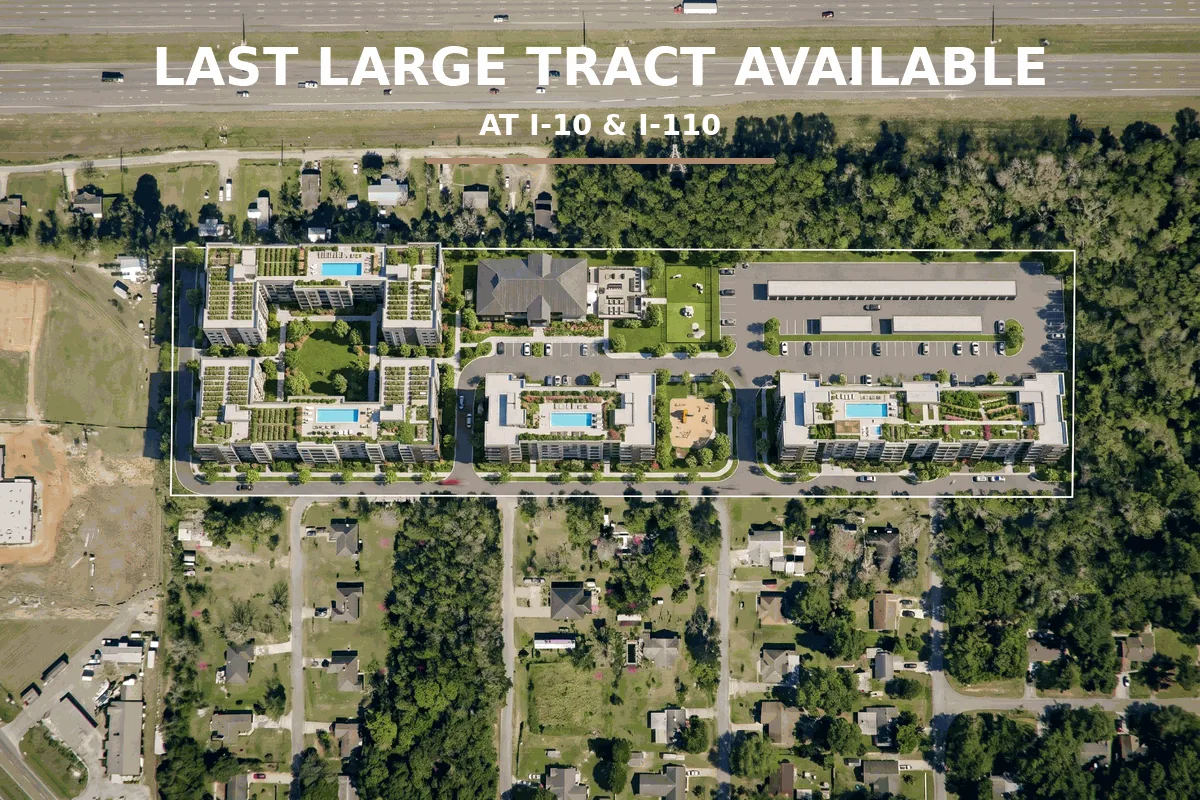
Retail site selection is the process of choosing a location that fits a business’s customers, operating requirements, and financial model. A disciplined review combines trade-area research with on-site inspection, access and zoning checks, and a realistic occupancy or development budget. High traffic alone does not establish that a site will work.
This checklist turns that process into a repeatable comparison for retailers considering the Gulf South. For the broader strategy, read our existing guide to retail site selection.
Define the store model before touring sites
Write down the target customer, required building size, lot requirements, parking, delivery access, signage, utility demand, and opening schedule. A quick-service restaurant with a drive-through needs a different test than a neighborhood service business or a destination showroom.
Set a total occupancy budget and identify non-negotiable requirements. Distinguish true deal breakers from preferences. This prevents an attractive location from shifting the criteria after the search begins.
Check the trade area against customer demand
Use population, household, income, and employment data as context—not as a sales forecast. The U.S. Census Bureau’s data portal provides public demographic information. Check the geography and release date behind each comparison, and distinguish residential customers from daytime workers and visitors.
Map competitors, complementary businesses, and your existing stores. A competitor can signal demand but also create competition; a gap in the map can reflect an opportunity or insufficient demand. Validate the interpretation through fieldwork and your brand’s own operating experience.
Verify traffic, visibility, and usable access
For Mississippi locations, the Mississippi Department of Transportation is a starting point for transportation and traffic research. Record the count location, measurement year, road segment, and whether the number describes both directions. Compare equivalent measures rather than mixing unrelated counts.
Drive the approach from the directions customers actually travel. Check medians, turning movements, driveway approvals, intersection queues, signage visibility, and shared-access agreements. A road with substantial traffic can still make your entrance inconvenient or inaccessible.
Visit at relevant times: morning, lunch, evening, or weekends depending on the concept. Road exposure should be tested against the customer journey, not treated as a promised conversion rate.
Test physical fit and permitted use
- Can the footprint, setbacks, parking, circulation, and loading requirements fit?
- Does zoning allow the exact use, including any drive-through or outdoor activity?
- Are utility service and capacity available on an acceptable timeline?
- Do easements, deed restrictions, or shared agreements constrain the layout?
- What drainage, flood, environmental, or soil questions require specialist review?
- Which permits and access approvals must be obtained before construction or opening?
Confirm these questions with the relevant authority and qualified consultants. A commercial zoning label, conceptual site plan, or utility line near a boundary does not alone establish approval or capacity for your project.
Compare the complete economics
For leased space, include base rent, CAM fees, taxes, insurance, utilities, fit-out costs, and maintenance responsibilities. For land or redevelopment, add acquisition, design, site work, utility connections, entitlement, financing, and contingency assumptions.
Keep one-time capital needs separate from recurring operating costs. Test a slower opening or weaker sales case instead of evaluating only the best scenario. A low asking price can be outweighed by access work or an unsuitable building.
Build a consistent shortlist
Use the same criteria for each candidate and document unresolved items. Mark each as verified, an assumption, or awaiting evidence. Eliminate sites that fail essential requirements rather than allowing a high total score to hide a critical problem.
Our portfolio provides real locations to investigate: Lamey Bridge and Interstate 10 in D’Iberville, Popps Ferry Road and Indian Drive in Biloxi, and Washington Avenue and Old Fort Bayou in Ocean Springs. These are starting points for due diligence, not claims that any site is approved or suitable for your concept. Confirm current availability and terms.
Move from comparison to a controlled decision
Coordinate commercial terms with legal and technical due diligence before committing. Align the decision schedule with inspections, approvals, and your business opening requirements. The SBA location guide reinforces the importance of target-market fit, location expenses, and zoning.
The Foundation Group offers site acquisition, tenant representation, and multi-market expansion. Send our team your site criteria, target markets, and timing to begin a location search grounded in your actual operating model.
Frequently asked questions
What should a retail site selection checklist include?
Include customer fit, trade-area data, competition, traffic and access, visibility, physical capacity, zoning, utilities, due diligence, timing, and total occupancy or development cost.
Is a high traffic count enough to choose a retail site?
No. Traffic must be evaluated alongside customer fit, usable entrances, turning movements, visibility, and the site’s physical and legal suitability for the business.
Where can I find demographic data for a Mississippi retail site?
The U.S. Census Bureau’s data portal is a public starting point. Check the geography and data release date, then supplement demographics with transportation research and site visits.
Can one checklist be used for a multi-market expansion?
Yes, consistent criteria support comparison, but each market and site needs local validation of access, permitted use, costs, utilities, and customer demand.